
New Language, Ancient Intelligence
There is something strange about the way we talk about wellness today. We hear that gut health may affect far more than digestion, that morning light matters for sleep and hormones, that turmeric contains compounds worth studying, or that when we eat may matter alongside what we eat.
Most of this is discussed through the language of modern science, which is appropriate. We now have tools that allow us to study mechanisms that earlier traditions could only observe through their effects.
But when you spend time with Ayurveda, some of these supposedly new ideas feel remarkably familiar.
Ayurveda has always placed digestion at the centre of health. Its daily routines are organised around changes in light, time of day and season. Food and spices are used not simply for calories or flavour, but according to the effects they are believed to have on the body. Mental and physical health are treated as deeply connected, while recommendations change according to the person, their environment and their stage of life.
The language is obviously different, and so is the underlying model of the body. What interests me is the resonance between them.
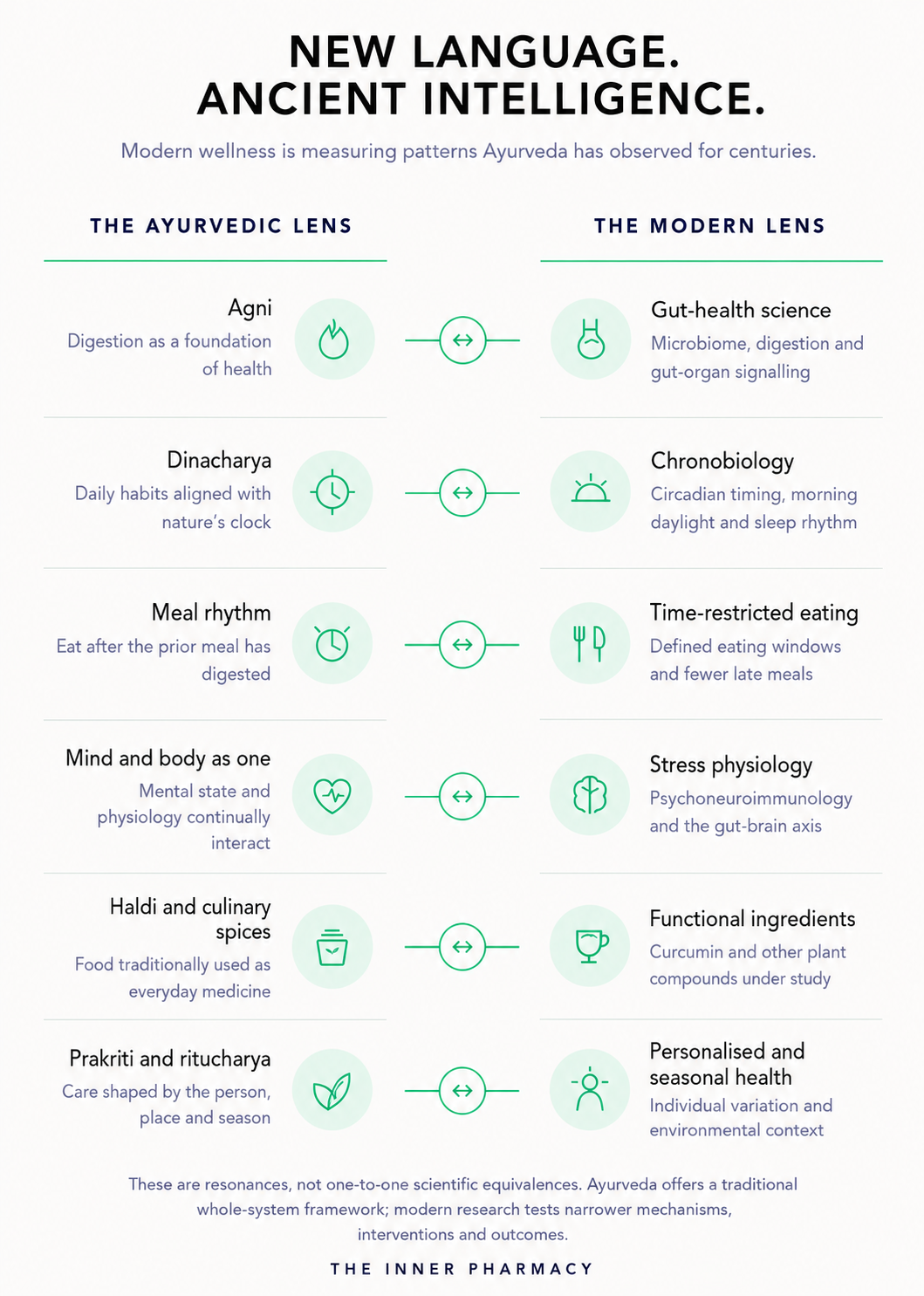
The two lenses are not the same. But they keep landing on the same ground. What strikes me is how often the modern conversation touches these topics without realizing it is circling something already known. The vocabulary may be fresh but the territory is ancient.
Ayurveda is a whole-system framework. Modern research is usually designed to isolate a variable, identify a mechanism or measure an outcome. One asks how the pieces behave under controlled conditions; the other has traditionally been more concerned with how those pieces behave together, in a particular person, living in a particular environment.
There is no need to choose between the two. The modern lens brings precision, data, and the ability to test. The Ayurvedic lens brings context, wholeness, and the long memory of a living tradition. Together they are more useful than either is alone. But for that to happen, the older voice has to be allowed into the room. Not as folklore or exotic background. As what it is: a system of observation that has been running for a very long time, and that has a great deal to say about the way we actually live.
This Week's Ritual
Notice one piece of modern health advice you have heard recently. Trace it back, if you can, to its older root. You may find that what sounds new is simply an old truth wearing new clothes.